
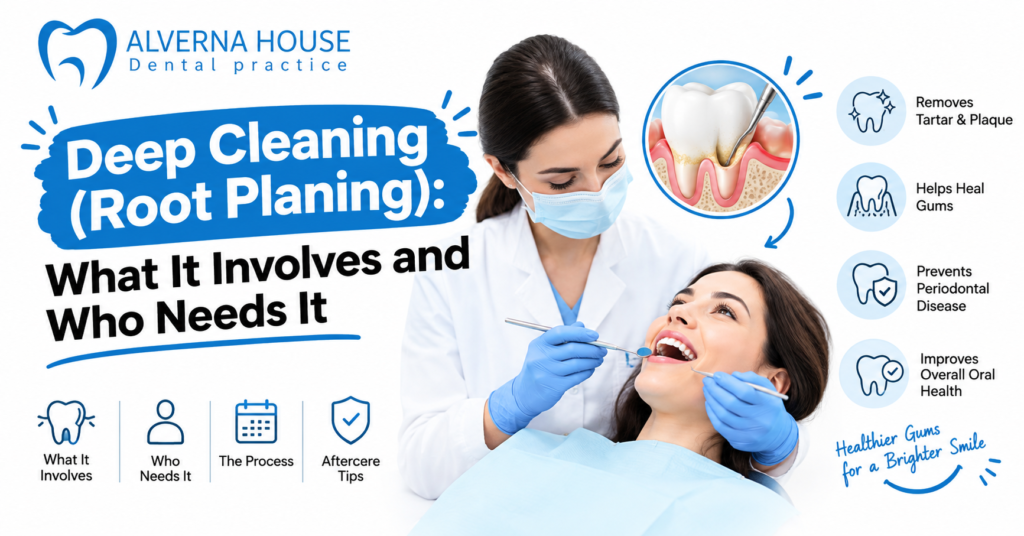
Deep cleaning, or root planing, is a two-part treatment that removes plaque and tartar from below the gumline and smooths the tooth root to treat gum disease. It is usually recommended once gum pockets reach four millimetres or deeper, a sign that periodontitis has developed beyond simple gingivitis
Your dentist has mentioned a “deep clean.” So, what does that actually involve? Deep cleaning, also called root planing, is a proven treatment for gum disease. This guide explains exactly what it involves, who needs it, and what to expect. It is far more thorough than a routine clean.
What Is Deep Cleaning (Root Planing)?
Deep cleaning, or root planing, is a treatment that cleans below the gumline to remove plaque and tartar from the tooth root. Unlike a standard clean, it treats the pockets that form between the gum and tooth. These pockets form once gum disease has progressed. In short, it targets bacteria a toothbrush simply cannot reach.
Deep cleaning has two parts. Scaling removes plaque and tartar from both above and below the gumline. Root planing then smooths the root surface itself, so bacteria find it harder to reattach and the gum has a better chance of healing back against the tooth.
Together, these two steps aim to calm the inflammation. They also reduce pocket depth and help stop the disease progressing further.
Why Deep Cleaning Matters
A routine scale and polish cleans the surfaces of your teeth, above and right at the gumline. It works well for healthy gums. However, once gum disease reaches a certain point, bacteria and tartar sit below the gumline. Normal brushing and a standard clean simply cannot reach that far.
Here is why deep cleaning matters so much:
- Gum disease left untreated can lead to permanent bone loss
- A standard clean cannot reach bacteria hiding below the gumline
- Deep cleaning is usually the first treatment tried, before anything surgical
- Catching the problem at this stage often saves teeth that would otherwise be at risk
- Good home care alone cannot undo damage that has already progressed this far
As a result, deep cleaning is not simply a longer version of a normal clean. It is a genuinely different, more targeted treatment. Skip it when you need it, and gum disease usually continues to progress quietly underneath the surface.
Picture a patient whose gums bleed occasionally, but never hurt. Their regular clean feels thorough, so they assume everything is fine. At a check-up, the hygienist finds several pockets measuring six millimetres. The bacteria driving that inflammation have been sitting below the gumline the whole time, completely out of reach of a normal brush or clean.
Who Needs Deep Cleaning?
Dentists recommend deep cleaning once gum disease has progressed to periodontitis, the more advanced stage beyond simple gingivitis. The main indicator dentists use is pocket depth, measured with a small probe during a check-up.
In a healthy mouth, the gap between the gum and tooth root usually measures between one and three millimetres. As gum disease develops, this pocket deepens. A pocket of four millimetres or more often signals infection below the gumline. A pocket of five millimetres or deeper strongly suggests that you need deep cleaning.
Other signs that may point towards deep cleaning include:
- Visible tartar below the gumline on an X-ray
- Gum recession that exposes more of the tooth root than before
- Bleeding gums that have not improved with better home care
- Persistent bad breath, despite good daily brushing
- Teeth that feel slightly loose or have shifted position
If several of these apply to you, it is worth discussing gum health properly at your next check-up.
What Happens During Deep Cleaning
Follow this general process to understand what a course of deep cleaning usually involves.
Step 1: A full assessment. Your dentist or hygienist measures pocket depths around every tooth and may take X-rays to check the bone level.
Step 2: Local anaesthetic. This numbs the area your dentist is treating, so the procedure itself should not be painful.
Step 3: Scaling. Your dentist or hygienist removes plaque and tartar from above and below the gumline, using ultrasonic or hand instruments.
Step 4: Root planing. Your dentist or hygienist smooths the root surface to discourage bacteria from reattaching.
Step 5: Splitting treatment across visits. Most dentists treat the mouth in sections, usually over two to four appointments, rather than treating everything at once.
Deep cleaning is usually completed over a few weeks, not in a single sitting. This keeps each appointment manageable. One area settles while your dentist treats another.
What to Expect Afterwards
Some mild soreness and sensitivity afterwards is normal, and it usually settles within a few days. Your gums may bleed a little when brushing for the first day or two, as the tissue begins to heal.
Cold sensitivity often increases slightly straight after treatment, before easing again over the following weeks. This happens because your dentist has now removed the tartar that had been sitting on the root surface, insulating it slightly. A soft-bristled brush and a desensitising toothpaste can help in the meantime.
Most patients return to a normal routine the same day. A follow-up appointment, usually six to eight weeks later, checks how well the gums have responded and measures pocket depths again.
Contact your dentist if pain gets noticeably worse rather than better, if swelling spreads rather than settling, or if you notice ongoing discharge. These are not typical and are worth checking properly.
Deep Cleaning and Ongoing Gum Health
Deep cleaning is not a one-off fix. Once the treatment is complete, gum health depends on consistent home care and regular professional maintenance. Plaque begins forming again almost immediately, so without good daily habits, gum disease can return.
Patients who have had a deep cleaning are often placed on a shorter recall schedule, seeing a hygienist every three to four months rather than the usual six. This ongoing supportive care is just as important as the deep clean itself.
There is also a genuine link between gum health and diabetes. The relationship works both ways. Diabetes makes gum disease more likely and more severe, while gum disease can make blood sugar harder to control. Because of this, patients with diabetes have good reason to treat gum health seriously and to keep up with maintenance visits once treatment is complete.
Key Benefits of Deep Cleaning
Deep cleaning brings real, lasting benefits when it is genuinely needed. For example:
- Reaches hidden bacteria. It removes bacteria a normal clean cannot reach, right at the source of the inflammation.
- Protects the bone. It can help prevent further bone loss around the teeth, before damage becomes permanent.
- Eases future maintenance. It reduces pocket depth, making future cleaning and maintenance genuinely easier.
- Improves breath. It often improves bad breath linked to gum disease, once your dentist removes the bacteria causing it.
- Protects your teeth. It gives teeth a genuine chance to be saved, rather than lost to advanced gum disease.
Altogether, these benefits make early treatment genuinely worthwhile, rather than something to put off.
Frequently Asked Questions
What is the difference between a normal clean and a deep clean?
A normal clean cleans the tooth surface above and at the gumline. A deep clean also cleans below the gumline, treating pockets caused by gum disease.
Is deep cleaning painful?
Most patients have the procedure done with local anaesthetic, so it should not be painful at the time. Some soreness afterwards is normal and usually settles within a few days.
How many appointments does deep cleaning take?
Most patients need two to four appointments, with each one treating a different section of the mouth.
How do I know if I need deep cleaning?
Your dentist or hygienist measures pocket depths during a check-up. Pockets of four millimetres or more usually indicate that deep cleaning is worth discussing.
Will I need deep cleaning again in future?
Ideally, once is enough, provided you keep up with home care and regular maintenance visits. Without this, gum disease can return over time.
Does deep cleaning help with bad breath?
Often, yes. Much of the bacteria that cause persistent bad breath sit below the gumline, exactly where deep cleaning targets.
Concerned You Might Need a Deep Clean?
A deep clean can sound daunting, but it is a well-established, effective treatment for gum disease. Alverna House Dental Practice offers thorough gum health assessments for patients across St Helens, whether through the NHS or privately. Left untreated, gum disease usually continues to progress quietly in the background. Get in touch today, and let’s check the health of your gums properly.