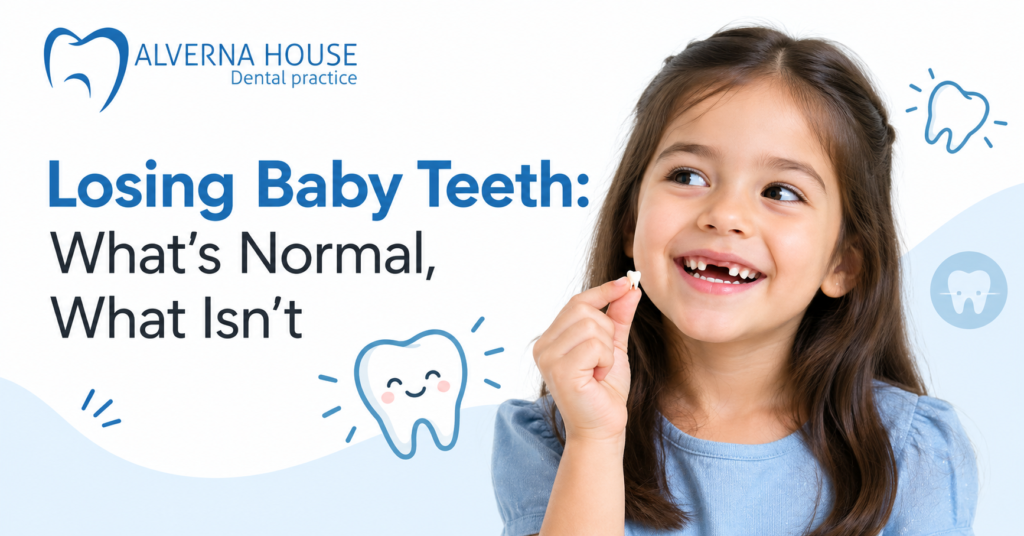
Children typically start losing baby teeth around age six, with the process continuing until around age twelve or thirteen; a little variation in timing is normal. Genuine warning signs include no teeth lost by age seven, a tooth lost very early from injury, or a permanent tooth appearing behind a baby tooth that has not loosened yet.
Most children lose their first baby tooth around age six. Some start earlier, some later, and both are usually fine. This guide explains the normal pattern for losing baby teeth, what genuinely counts as a red flag, and what to do if things do not go quite to plan.
What Does It Mean When a Child Loses a Baby Tooth?
Losing baby teeth is the natural process where primary teeth loosen and fall out to make room for permanent teeth underneath. It usually starts around age six and continues until around age twelve or thirteen. In short, it is a normal, expected part of growing up, not something to worry about by default.
Losing a baby tooth happens when the permanent tooth developing underneath slowly dissolves the root of the tooth above it. Once the root is gone, the baby tooth loosens, and eventually falls out on its own.
This process usually starts around age six, though it can begin up to a year earlier or later. By around age twelve or thirteen, most children have all their adult teeth in place.
Why This Matters So Much
Every child’s mouth works on its own timetable. A little variation from the average is genuinely normal, and rarely means anything is wrong.
Losing a first tooth is a genuine milestone, and children react to it in very different ways.
Some children feel excited straight away, proud to show off the gap. Others feel genuinely anxious, worried it might hurt, or unsettled by the idea of losing part of their body. Both reactions are completely normal, and neither needs correcting.
Here is why understanding this matters so much:
- Most tooth loss follows a broadly predictable pattern, which helps you know what to expect
- A little variation in timing is genuinely normal, not a cause for concern
- A small number of genuine warning signs do need a dentist’s attention
- Staying calm, rather than assuming the worst, helps your child feel calm too
- Catching a real problem early makes it far easier to treat properly
Picture two children, both losing their first tooth around the same time. One feels thrilled, already planning what to tell friends at school. The other feels nervous, unsure what to expect next. Both reactions are entirely normal. A calm, simple explanation helps either child feel more settled about what happens next.
The Tooth-by-Tooth Timeline
Baby teeth usually fall out in roughly the same order they first came in, though every child varies a little.
- Front teeth (central incisors), typically age 6 to 7. These are almost always the first to go, usually starting with the bottom front teeth.
- Next to the front teeth (lateral incisors), typically age 7 to 8. These follow shortly after the central incisors.
- Back chewing teeth (first molars), typically age 9 to 11. These do a lot of chewing work, and tend to loosen around a similar time to the canines.
- Pointed teeth (canines), typically age 9 to 12. These often hang on a little longer than the front teeth.
- Final back teeth (second molars), typically age 10 to 12. These are usually the last baby teeth to go.
| Tooth Type | Typical Age Lost |
| Central incisors (front teeth) | 6–7 years |
| Lateral incisors | 7–8 years |
| First molars | 9–11 years |
| Canines | 9–12 years |
| Second molars | 10–12 years |
A tooth falling out of this exact order is not usually a problem on its own. Genetics plays a real role too, so a family pattern of earlier or later tooth loss is worth bearing in mind.
Signs Worth a Dental Check
Most variation in timing needs no action at all. A few specific signs, however, are genuinely worth mentioning to a dentist:
- No teeth lost at all by around age seven
- A tooth lost very early, before age four, especially due to injury
- A permanent tooth appearing behind a baby tooth that has not loosened yet, sometimes called “shark teeth”
- Pain, swelling, or bleeding that does not settle down after a tooth falls out
- A tooth becoming loose because of an injury, rather than the natural process
Noticing one of these signs does not mean something is seriously wrong. It simply means a proper check is genuinely worth booking.
What to Do If a Permanent Tooth Gets Knocked Out
A baby tooth coming out naturally is completely normal. A knocked-out permanent tooth is different, and needs quick action.
If this happens, follow these steps. Find the tooth, and pick it up carefully by the crown, never by the root. Rinse it gently with water, without scrubbing it. Try to place it back in the socket if you can do so easily. If not, keep it in milk, or in the child’s own saliva, and get to a dentist immediately. Acting quickly genuinely improves the chances the tooth can be saved.
Step-by-Step: Supporting Your Child Through This
Follow this general process to help your child through losing their teeth calmly.
Step one is to explain the process simply, before it happens, so nothing feels surprising. Step two is to acknowledge how your child actually feels, whether that is excitement or nerves. Step three is to keep regular dental check-ups going, so any genuine issue gets caught early. Step four is to encourage gentle wiggling, rather than forcing a tooth out before it is ready. Step five is to know the specific signs worth checking, so you can act calmly if one appears.
Following this process helps your child feel supported, rather than anxious, throughout the whole process.
Key Benefits of Knowing What’s Normal
Understanding this properly brings real, practical benefits. For example:
- Less unnecessary worry. Knowing the normal range means small variations do not cause alarm.
- Faster action when it genuinely matters. Recognising real red flags means you act quickly when needed.
- A calmer child. Your own calm approach genuinely helps your child feel settled too.
- Better long-term dental health. Catching a real issue early often means simpler treatment.
- Real peace of mind. Clear understanding replaces vague worry with confidence.
Altogether, these benefits make understanding this process genuinely worth a few minutes of your time.
Frequently Asked Questions
At what age do children usually start losing baby teeth?
Most children lose their first baby tooth around age six, though starting a year earlier or later is still considered normal.
Does it matter if teeth fall out in a different order?
Not usually. While there is a typical order, plenty of healthy children lose teeth in a different sequence without any issue.
What are “shark teeth”?
This is when a permanent tooth appears behind a baby tooth that has not yet fallen out. It is common, and usually resolves on its own, though it is still worth a dental check.
Should I pull out a loose baby tooth myself?
Gentle wiggling is fine, but forcing a tooth out before it is ready is not recommended. Let the process happen naturally.
What should I do if my child’s permanent tooth gets knocked out?
Pick it up by the crown, rinse it gently, and try to place it back in the socket if possible. If not, keep it in milk and get to a dentist immediately.
When should I book a dental check about tooth loss?
Book one if no teeth have been lost by around age seven, if a tooth is lost very early due to injury, or if you notice pain, swelling, or persistent shark teeth.
Not Sure If Your Child’s Tooth Loss Is Normal?
Most tooth loss follows a normal, predictable pattern, and rarely needs any action at all. Alverna House Dental Practice supports families across St Helens with clear, honest guidance, whether through the NHS or privately. Every child develops slightly differently, so a proper check-up gives you real answers, rather than guesswork. Get in touch today, and let’s talk through exactly what to expect for your child.
Also read:https://alvernahouse.co.uk/thumb-sucking-child-teeth-when-to-worry/